
“Imposter syndrome doesn’t care how many degrees you have, what your title says, or how hard you’ve worked to get where you are.”
There’s a strange kind of silence that creeps in when you land a role you’ve worked your entire life to earn; like you feel like you’ve somehow tricked everyone into giving it to you.
I know that silence well.
It shows up the moment you hit “send” on a big project, convinced someone is going to discover a flaw you missed. It shows up in boardrooms, Zoom calls, and late-night email rewrites. It doesn’t care about your GPA, your glowing recommendations, or your certifications.
Imposter syndrome doesn’t ask if you’re qualified. It convinces you you’re not.
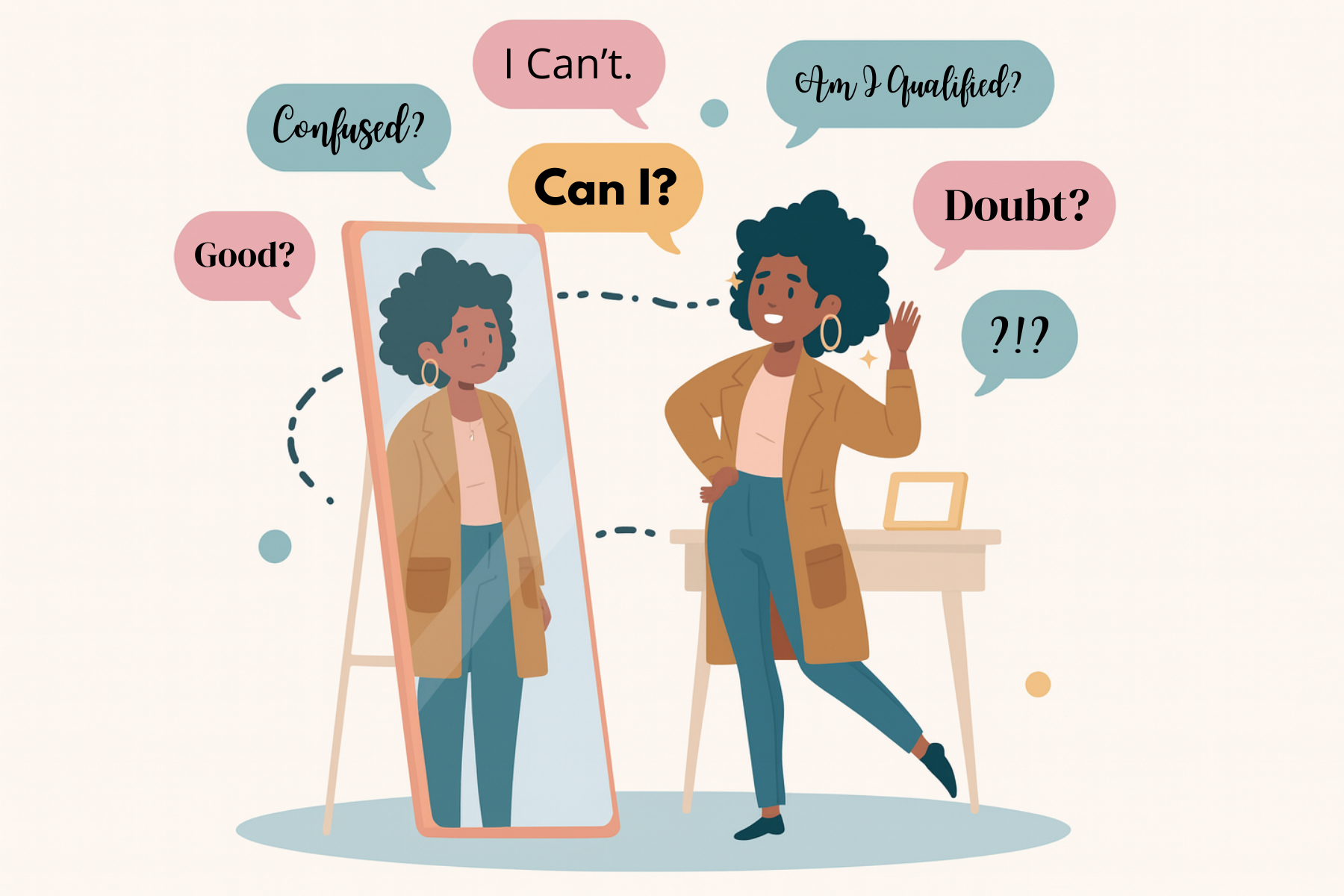
The mind can be a deceptive place, often throwing at you a reel of what you perceive to be evidence for your shortcomings and incompetencies. This internal narrative is relentless, often leading to second-guessing even the simplest of decisions or actions. But here’s the thing: imposter syndrome thrives in high-achievers. It feeds on responsibility, perfectionism, and progress. The more successful you are, the more intense this inner dialogue can become, causing a cycle where success equates to increased self-doubt.
While it can feel isolating, it’s one of the most common quiet battles in fast-paced, high-pressure careers. The truth is, so many of your colleagues and peers are wrestling with the same feelings of self-doubt and insecurity. Understanding this shared experience can be liberating. Acknowledging these feelings, talking about them, and normalizing the experience can bring clarity and a sense of connection that counters the isolating tendency of these thoughts.
Where Imposter Syndrome Hides (and Thrives)
Imposter syndrome doesn’t always look like insecurity. Sometimes it shows up as:
- Over-preparing for every meeting to “prove” your worth
- Downplaying your accomplishments as “luck” or “timing”
- Avoiding taking credit because you “didn’t do it alone”
- Holding back ideas out of fear of sounding “stupid”
- Constantly comparing your behind-the-scenes with everyone else’s highlight reel
In high-responsibility roles like project management, operations, engineering, or leadership, the stakes are high, and so is the pressure to be right. There’s no manual for being the youngest in the room or the only woman in a technical field. And when the pace is fast, there’s often no time to celebrate small wins before jumping to the next challenge.
That’s the perfect storm for imposter syndrome to settle in.
My Personal Wake-Up Call
I remember the moment it hit me. I had just wrapped a major cross-functional project with global visibility. It went well—better than expected, in fact. But instead of celebrating, I spiraled.
Was I just lucky that the vendors responded on time?
Was it really my leadership, or did the team just know what to do without me?
Did I actually add value, or was I just a well-organized middleman?
I found myself nitpicking the one line of an email I should’ve phrased better. I ignored the 100 other things I did right. Each thought became a heavy stone in my mind, dredging up doubts and insecurities I barely acknowledged.
Later that night, I decided to confront those feelings. I took a sheet of paper and began to list every major contribution I had made to that project: the countless hours of planning, the strategic alignment sessions, and the effective communication I’d fostered between various teams. Each bullet point grew, revealing the breadth of my efforts and the impact they had.
By the end of the list, something clicked. It dawned on me that my role was far more significant than I had allowed myself to believe. I wasn’t just a facilitator; I was driving the team towards success. The recognition I had sought externally had to come from within. This was a pivotal moment for me, not just in my career but in understanding my own self-worth and capabilities. Looking at that list, I realized that every project’s success is never solely the result of luck or the talents of others but is often the culmination of countless unseen efforts.
Reframing the Narrative
Imposter syndrome whispers, “You don’t belong here.”
Confidence responds, “You built your way here.”
Here are a few ways I’ve learned to quiet the inner critic and lean into my value:
1. Track the Facts, Not the Feelings
Keep a “confidence file”. Whether it’s a folder, journal, or note on your phone where you record positive feedback, successful outcomes, and even small wins.
When doubt creeps in, revisit the evidence.
2. Celebrate Before You Critique
When finishing a big project or milestone, pause. Ask yourself: What went right because of me? Before dissecting improvements, take time to own your impact.
3. Practice Saying Thank You
When someone praises your work, resist the urge to deflect or downplay. Just say, “Thank you.” Receiving recognition doesn’t make you arrogant! (*Note to Self*) It makes you accountable.
4. Seek Mentors Who Tell the Truth
Find people who see your potential and your progress. The right mentors won’t just hype you up, they’ll challenge your blind spots and help you level up with honesty.
5. Normalize the Discomfort of Growth
The higher you go, the newer it all feels. That discomfort? It’s not failure—it’s growth. Being slightly out of your depth means you’re learning.
You’re Not Alone and You’re Not a Fraud
Imposter syndrome doesn’t care how many degrees you have, what your title says, or how hard you’ve worked to get where you are. It’s an inescapable feeling that can seep into your thoughts, whispering doubts about your worth and capabilities. And, it doesn’t go away overnight. Overcoming it is a journey that requires patience and persistence. But the more you name it, the less power it holds. Acknowledging these feelings is the first step towards claiming your achievements and recognizing your worth.
You’re not behind, you’re building.
You’re not unqualified, you’re becoming.
In this shared journey, remember that it’s normal to feel doubt from time to time; these moments of uncertainty are part of the human experience. You are absolutely not alone in feeling this way, as many have walked this path before you. Even the Trailblazers felt it,

Dr. Mae Jemison, the first Black woman to travel to space, has spoken openly about doubting herself during her journey to NASA. Despite being a trained physician, engineer, and astronaut, she said:
“Sometimes people internalize the feeling that they’re
not good enough… You have to push past that.”

Dr. Fei-Fei Li, one of the leading minds in artificial intelligence, admitted that early in her career, she constantly questioned whether she was smart enough to be in the room.
“It’s okay to feel small. I still do sometimes. But together
we can be big enough to accomplish anything.”

Reshma Saujani, founder of Girls Who Code, shares in her book Brave, Not Perfect how imposter syndrome nearly kept her from launching the organization that’s since empowered thousands.
“The bravery deficit among women is real,” she writes. “We’re so busy trying to be perfect that we hold ourselves back.”

Even Sheryl Sandberg, former COO of Facebook and author of Lean In, has also spoken publicly about feeling self-doubt even after reaching high levels of professional success. She confessed:
“There are still days I wake up feeling like a fraud…
like I don’t belong here.”
These women didn’t let doubt define them.
They let it drive them.
Final Thoughts:
You Belong Wherever You Find Yourself
When we normalize confidence, we de-stigmatize growth. This process allows individuals to embrace their achievements and aspirations without the weight of doubt or shame. It creates an environment where everyone feels empowered to strive for excellence, fostering a culture that values progress and supports personal development.
When we own our wins, we pave the way for others to do the same.
And when we trust our voices, even in high-stakes rooms, we change the culture: one meeting, one project, one quiet win at a time. Each time we speak up, we challenge the status quo and push for inclusivity. It becomes easier for others to join the conversation, creating a rich tapestry of diverse perspectives and innovative ideas.
So the next time that whisper says, “You don’t belong here,” recognize that this is merely an echo of insecurity. Instead, answer back confidently:
“I do now.”
This affirmation can be a powerful declaration of self-worth, reminding us that we indeed have a place in every conversation, every decision, and every opportunity. By asserting our presence, we not only validate ourselves but also inspire others to embrace their rightful places as well. Embrace the strength of your voice and be a catalyst for change.






 Olivia N. Wright
Leave a comment